
Best Canadian Universities for International Undergraduates Seeking Research Experience
Nov 17, 2026 • 10 min read
Explore five of Canada's best universities for international undergraduates seeking research experience: the University of Toronto, UBC, University of Alberta, University of Guelph, and University of Calgary. Learn about their undergraduate research programs, summer assistantships, eligibility requirements, supervisor expectations, and application processes to help plan an academic research pathway.
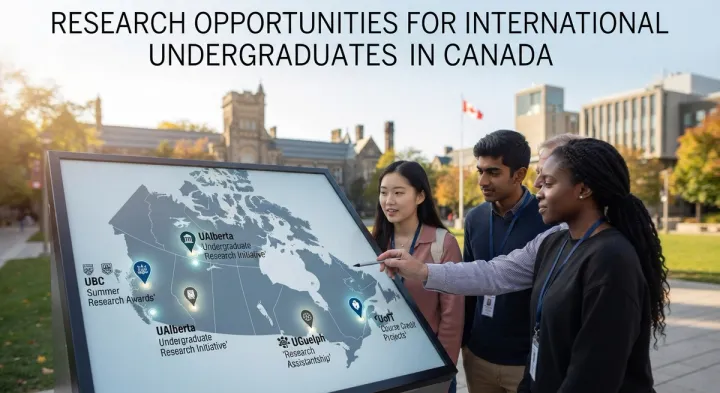
International undergraduates who are considering graduate school may want to try research during a Canadian degree.
Working with a supervisor gives them a chance to develop an idea, examine their findings and discover which parts of the process they enjoy.
To make room for that work, applicants can look at research opportunities while choosing a university.
A project for course credit and a full-time summer assistantship require different schedules, so students can consider which would suit their academic plans and when they hope to begin.
1. University of Toronto
The University of Toronto's Research Opportunities Program offers course-credit projects with an instructor.
The Arts & Science route at St. George is open to applicants entering second or third year who have completed between 4.0 and 13.5 credits.
Before choosing courses, applicants can check the degree calendar and ask how a research project would fit their academic plans.
They need to check any prerequisites and find a project that suits their interests and meets the course requirements.
Toronto has three campuses, and this particular route belongs to St. George. It should not be treated as a single research application covering St. George, Mississauga and Scarborough.
Students apply through CLNx. Entry to the degree does not place a student in the Research Opportunities Program, and first-year applicants cannot assume immediate access to this second- and third-year route.
Prospective students can investigate this route before enrolling, then use the early part of the degree to learn its course and application requirements.
It gives them a specific research opportunity to consider alongside the university's reputation.
2. University of British Columbia
International undergraduates who want a sustained summer project should consider the University of British Columbia's Vancouver campus.
Its Work Learn International Undergraduate Research Awards support supervised full-time research lasting at least 16 weeks over the summer.
The awards are for international undergraduates, so applicants do not have to infer eligibility from a general student research page.
Eligibility includes international undergraduate enrolment at Vancouver, a valid study permit and Social Insurance Number, presence in British Columbia and the stated full-time study or scheduled-break conditions. Exchange and visiting students are excluded.
A student considering the Okanagan campus needs to investigate that campus's opportunities separately.
Meeting the conditions does not guarantee a research position. Students still need to secure a supervised opportunity.
The full 16-week project needs to fit around the student's academic schedule and other obligations.
Participation is limited to one award per fiscal year and three over the degree, which also affects plans for repeat summer research.
Vancouver International Student Advising can help with study-related immigration and work questions.
Students can use that advice to check eligibility, while selection for a research opportunity remains separate.
3. University of Alberta
At the University of Alberta, students can get help turning an interest into a research proposal.
Its Undergraduate Research Initiative works with students in any discipline and year, from an initial enquiry through presenting or publishing work.
Advisers can help students find opportunities, while workshops and seminars give them ways to learn about the research process.
For the streamlined competition, students need a confirmed eligible faculty supervisor. They must be enrolled in an eligible undergraduate degree and have at least satisfactory academic standing.
Applicants submit their own proposals, and individual opportunities can impose further conditions.
Students can use the advising service before deciding whether a competition suits their interests and academic record. Finding a supervisor remains part of the application.
4. University of Guelph
The University of Guelph offers supervised summer research through the International Student Undergraduate Research Assistantship.
International undergraduates can apply for competitive positions that typically last 16 weeks, giving them a sustained project alongside a faculty member.
Current students returning to their bachelor's degree in the following fall can apply through Experience Guelph.
The usual cumulative-average requirement is at least 70%, with departmental criteria and faculty-approved waivers considered during selection. The program offers up to eight positions.
Applicants comparing undergraduate international student courses at the University of Guelph can also explore faculty-supervised independent research projects within their degree.
A program adviser can explain how a project earns academic credit and how students arrange supervision.
The assistantship concentrates research in the summer, while an academic project connects it to the student's course of study.
Students can discuss their interests with faculty and use the current Experience Guelph application cycle to plan their next step.
5. University of Calgary
The University of Calgary invites students across undergraduate faculties and years to investigate UREX Summer, including students in their first year.
Supervised projects can last eight, 12 or 16 weeks between May and August. Applicants can discuss which length suits their proposed work and available time.
Applications require an approved supervisor, a proposal and a supervisor reference.
Eligibility differs between research routes, so applicants need to read the conditions for the route they choose alongside the general summer program information.
The UREX Award, formerly called PURE, is open across faculties to continuing undergraduates in good standing.
Its requirements include a minimum cumulative grade point average of 2.0 and continuation into the following fall term.
Students who have completed their degree requirements or plan to graduate in June are ineligible.
Students report on their projects afterwards and can share their work through UREX Fest or the Students' Union Undergraduate Research Symposium.
Applicants can discuss with a prospective supervisor what they hope to learn and how they might present their work.
Preparing for a first research project
Students can shortlist universities by the research they want to try and when they could begin it during the degree. A course-credit project and a full-time summer assistantship demand different schedules.
The student can compare those commitments before making the university decision.
For each likely route, the applicant should record the eligible year of study, the academic conditions and whether a supervisor must agree before the application. International eligibility needs its own check.
An award requiring citizenship or permanent residence cannot be treated as an alternative simply because it appears on the same undergraduate research website.
An undergraduate research adviser or program contact can explain how to approach supervisors and which documents the current cycle requires. A prospective supervisor can discuss the proposed work.
Those inquiries help students plan a first project without assuming that university admission arranges it for them.