
A High GPA Doesn't Guarantee College Admission. Here's What Colleges Are Really Looking For.
Sep 9, 2026 • 12 min read
A high GPA can strengthen a college application, but it does not guarantee admission. This guide explains what selective colleges really look for, including academic rigor, intellectual curiosity, problem-solving, meaningful extracurriculars, essays, resilience, and genuine subject mastery.
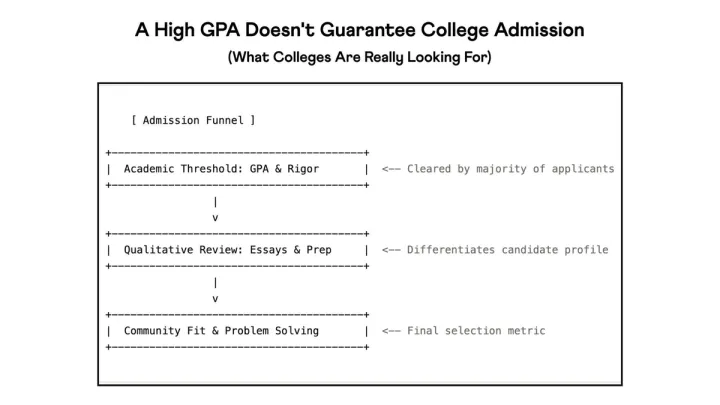
There are a lot of instances where students with almost perfect GPAs get deferred, waitlisted, or rejected from colleges, while classmates with slightly lower grades get in.
This is quite ironic in the sense that students are trained to chase GPA since early high school.
The fact is: High GPA gets an application considered. It does not decide who receives an offer.
Why GPA Is Just a Baseline, Not the Final Decision-Maker?
A popular article from MIT’s admissions office wrote that selective colleges like MIT don't just want a room full of high test scores and perfect report cards. They said they are trying to build a community, not just fill seats with the highest-scoring applicants.
According to NACAC's State of College Admission report, grades in challenging college-prep courses are one of the most valued factors in admissions decisions. It was rated "considerably important" by 79.2% of colleges. But that is still not 100%.
Almost every other applicant already has a high GPA, therefore, GPA stops being the deciding factor at top schools. Besides academic benchmarks, admissions officers look at other details:
- How a student thinks
- What topics they are truly passionate about
- How they describe their own learning journey
A perfect GPA proves a student can handle tough schoolwork. It’s great for starters, but not the finish line.
So What Are Admissions Officers Actually Looking For?
Selective schools have been fairly open and honest about their requirements. Caltech’s articles on essay writing and admission help are a good example to quote here.
- Depth over quantity: Colleges prefer deep engagement in one or two areas over a long list of random clubs.
- Problem-solving skills: They want to know how a student thinks through a problem, not just that they got the right answer.
- Honesty about failure: Colleges value students who can talk about setbacks, what went wrong, and how they learned from it.
- Creating vs. attending: They look for students who build, design, or solve things, rather than just show up to meetings.
Math is Where the Gap Between Grades and Understanding Shows Up Most
Out of all subjects, math is most cumulative. Each math concept is connected to previous concepts that a student learns. Because of this, a high math grade doesn't always mean a student truly understands the concept in application.
This issue often goes unnoticed until a student takes a higher-level course or a college placement exam, and there’s plenty of data on it:
- Placement gaps: At UC San Diego, over 25% of students placed into remedial math had earned a 4.0 in high school math.
- Surface-level learning: Nationally, many students learn to memorize steps to pass Friday's test, but struggle to apply those concepts later on.
- Teacher pressure: Many high school teachers report feeling pressured to keep grades high, which can hide whether a student is truly ready for college-level work.
Nationally, ACT's own data for the Class of 2025 confirms this isn't a small gap: out of the nearly 1.4 million graduates who took the ACT in 2025, only 20% met all four of its college-readiness benchmarks, and just 30% met three or more.
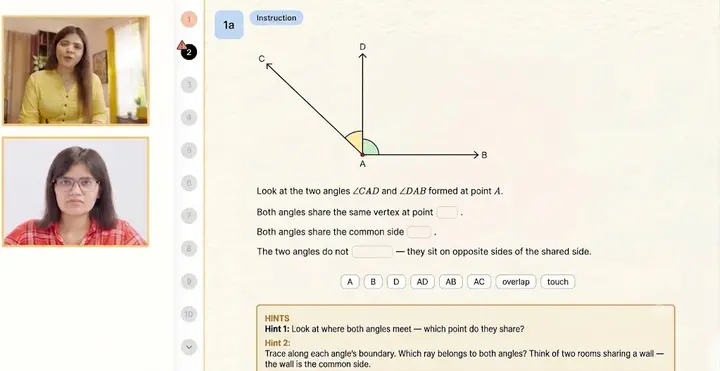
To bridge this gap before entering college, students are moving away from traditional rigid tutoring and turning toward flexible, personalized online math programs like Cuemath.
By combining live 1:1 online math classes with expert tutors who focus on 'why' concepts work rather than just memorizing steps, platforms like this offer the exact balance high schoolers need: 100% schedule flexibility alongside deep, college-ready conceptual mastery.
Does This Mean GPA Doesn't Matter?
It would be easy to conclude from all this that GPA does not matter. But no, that is not the case.
A student’s high school GPA remains one of the best predictors of whether they will actually finish their college degree.
Think of it this way:
- GPA proves academic habits. It shows colleges that a student has the discipline to complete a degree.
- GPA doesn't prove deep mastery. It doesn't show if a student has truly mastered complex subjects, nor does it guarantee admission when competing against thousands of other straight-A applicants.
Key Takeaways for Students
Before we summarise key takeaways, it is important to understand the point here. None of this replaces grades. It is additional information colleges use alongside them.
A high GPA still tells a college a student can handle the coursework. It does not tell them anything else, and selective schools have been saying so, directly, for years.
- Focus on depth: Pursuing one project or interest deeply over time is more impressive than joining eight different clubs.
- Use essays and interviews to show thinking, not just results. Describe how a hard problem got worked through, including the part where it did not go well at first.
- Be honest about what was difficult. Admissions officers read thousands of essays that sound the same. A specific, honest account of struggle stands out precisely because it is rare.
- Check whether you can explain your thinking and the overall concept, not just the answer, especially in math. If you notice gaps between your grades and your actual understanding, turn to specialized platforms like Cuemath. Through tailored 1:1 coaching that guides you through problem-solving without just giving away answers, Cuemath tutors help you build the exact high-level analytical reasoning and confidence required for top college programs.
- Show a consistent pattern over time, rather than one flawless semester. A trend an admissions officer can verify across years is more convincing than a single perfect data point.