
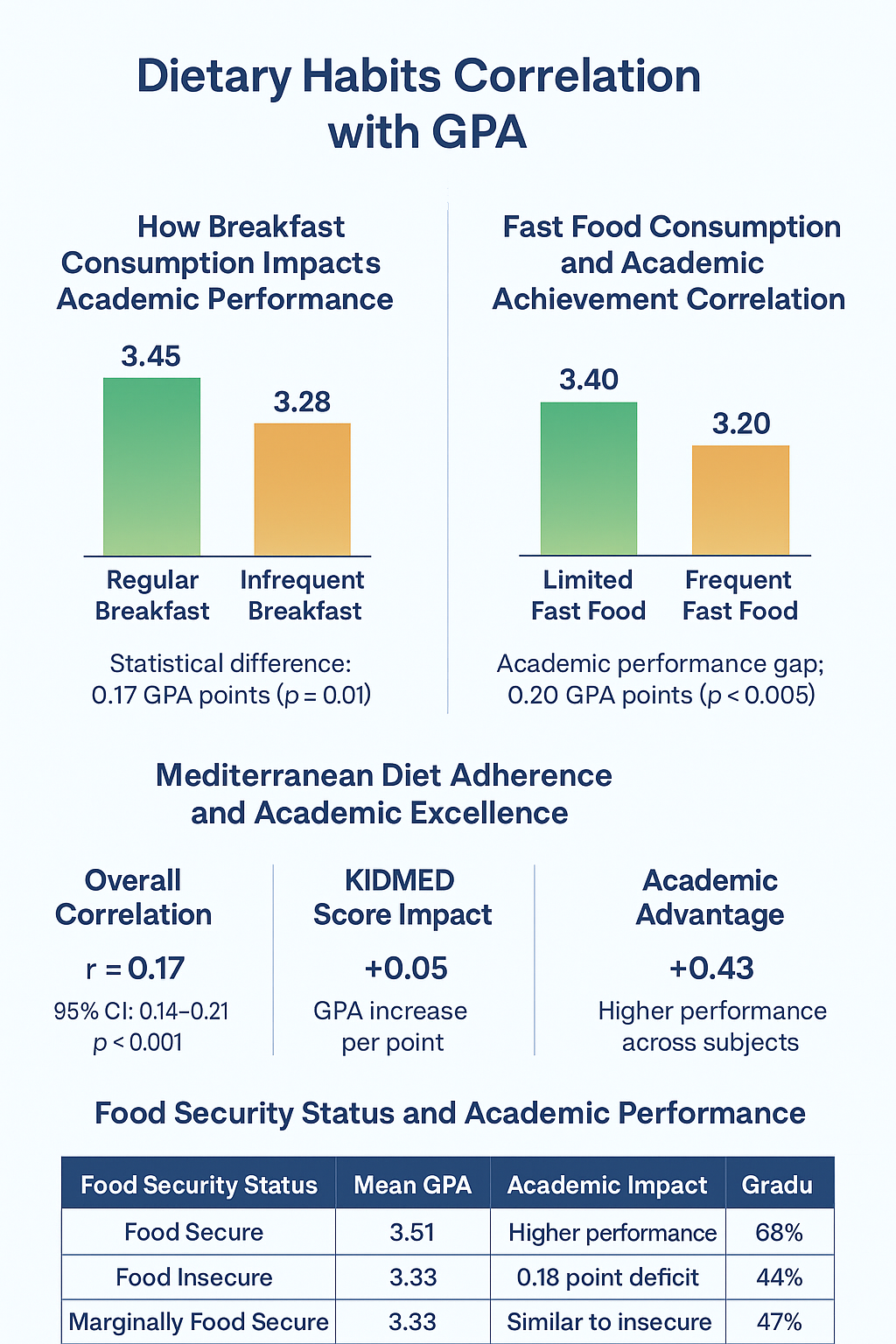
Dietary Habits Correlation with GPA (2025)
Academic performance among students has become increasingly linked to nutritional choices, with comprehensive research revealing significant correlations between dietary habits and Grade Point Average outcomes. Modern educational institutions and researchers are examining how specific eating patterns influence cognitive function, concentration levels, and overall scholastic achievement.
How Breakfast Consumption Impacts Academic Performance
Regular breakfast consumption emerges as one of the most significant dietary factors affecting student GPA. Research consistently demonstrates that students who maintain consistent morning meal routines achieve measurably higher academic outcomes compared to those who frequently skip breakfast.
Breakfast Frequency vs GPA Performance
Statistical difference: 0.17 GPA points (p = 0.01)
Students who consumed breakfast at least five days per week demonstrated a mean GPA of 3.45, significantly outperforming peers who ate breakfast two days or fewer per week, who averaged 3.28. This 0.17-point difference represents a statistically significant improvement that can influence academic standing and scholarship eligibility.
Fast Food Consumption and Academic Achievement Correlation
The relationship between study hours vs GPA becomes more complex when dietary quality enters the equation. Fast food consumption patterns show particularly strong negative correlations with academic performance across multiple demographic groups.
Weekly Fast Food Intake and GPA Outcomes
Academic performance gap: 0.20 GPA points (p < 0.005)
Students consuming fast food twice or more weekly averaged a GPA of 3.20, while those limiting consumption to once weekly or less maintained an average of 3.40. This 0.20-point differential suggests that frequent fast food consumption serves as a negative predictor of academic success, potentially due to poor nutrient quality affecting cognitive function.
Ultra-Processed Food Impact on Student Achievement
Recent studies examining ultra-processed food consumption reveal concerning trends regarding academic performance. Students with high ultra-processed food intake consistently score lower across multiple academic domains, including mathematics, language arts, and foreign language competency.
Mediterranean Diet Adherence and Academic Excellence
Mediterranean dietary patterns demonstrate the strongest positive correlation with academic achievement among all measured nutritional approaches. This eating style, emphasizing fruits, vegetables, whole grains, legumes, fish, and olive oil, consistently associates with improved cognitive function and scholastic performance.
Overall Correlation
95% CI: 0.14-0.21
p < 0.001
KIDMED Score Impact
GPA increase per point
p < 0.001
Academic Advantage
Higher performance
across subjects
Meta-analysis research involving 16 studies found a Pearson correlation coefficient of r = 0.17 between Mediterranean diet adherence and academic performance. While considered modest, this relationship proves statistically significant and demonstrates consistency across diverse student populations and educational systems.
KIDMED Score Relationship with Grade Point Average
The Mediterranean Diet Quality Index for children and adolescents (KIDMED) provides quantifiable measurements of dietary adherence. Portuguese secondary school studies involving 773 students revealed that each single-point increase in KIDMED score predicted a 0.05 increase in GPA on a four-point scale.
Food Security Status and Academic Performance
Food insecurity emerges as a significant barrier to academic success, with income bracket and GPA correlation studies revealing substantial performance gaps between food-secure and food-insecure student populations.
Food Security Impact on Academic Achievement
| Food Security Status | Mean GPA | Academic Impact | Graduation Rate |
|---|---|---|---|
| Food Secure | 3.51 | Higher performance | 68% |
| Food Insecure | 3.33 | 0.18 point deficit | 44% |
| Marginally Food Secure | 3.33 | Similar to insecure | 47% |
Food-secure students maintain an average GPA of 3.51, while food-insecure peers average 3.33, representing a 0.18-point academic penalty. This disparity extends beyond grades, with food-insecure students demonstrating graduation rates of 44% compared to 68% among food-secure students.
Psychosocial Factors Mediating Food Insecurity Effects
Research examining college students across Georgia universities found that psychosocial health mediates approximately 73% of the relationship between food insecurity and academic performance. Food insecurity correlates with increased depression and anxiety while reducing hope levels, subsequently affecting academic outcomes.
Beverage Consumption Patterns During Academic Periods
Examination periods reveal specific beverage consumption patterns that correlate with academic performance. Lebanese studies involving 608 students during exam periods identified several concerning correlations between daily beverage intake and GPA outcomes.
Daily Coffee Intake
p = 0.003
Daily Tea Consumption
p = 0.005
Fast Food During Exams
p = 0.004
High caffeine consumption during examination periods consistently correlates with lower academic performance, suggesting that excessive stimulant intake may impair rather than enhance cognitive function during critical academic periods.
Environmental and Social Factors Affecting Nutrition Choices
Campus food environments significantly influence student nutritional behaviors and subsequent academic outcomes. Public vs private institution averages demonstrate varying access to healthy food options across different educational settings.
Peer Influence on Dietary Decision Making
University campus studies reveal that students demonstrate a 14% increased likelihood of purchasing identical food items as their peers during sequential food purchases. This social mimicry pattern proves strongest for condiments and suggests that peer influence substantially affects dietary choices that shape long-term academic performance.
Post-Pandemic Dietary Pattern Changes
Following COVID-19 lockdowns, 76.5% of surveyed students reported decreased homemade food consumption, while 23.5% increased restaurant food intake. Reduced nutritious home-prepared meals correlated with self-reported declines in academic focus, though formal GPA measurements were not conducted in these studies.
Socioeconomic Factors and Nutritional Access
Low income and solitary living arrangements predict poorer eating habits, which directly link to reduced GPA outcomes. Merit-based vs need-based scholarships research indicates that financial constraints significantly impact both food security and academic achievement.
Campus Food Environment Assessment
Food environment factors including campus dining hall offerings, affordability, and nutritional labeling play pivotal roles in determining dietary quality. Universities with comprehensive nutritional support programs demonstrate improved student academic outcomes across multiple measures.
Technology Integration and Academic Performance Analysis
Modern educational institutions increasingly utilize technological tools to track both dietary patterns and academic outcomes. AI-powered tutoring impact on GPA studies suggest that integrated approaches combining nutritional guidance with academic support produce optimal results.
Digital Health Monitoring and Student Success
Universities implementing digital health monitoring systems report enhanced ability to identify at-risk students based on dietary patterns. Screen time habits and GPA variance research demonstrates interconnections between lifestyle factors and academic achievement.
Practical Implications for Educational Policy
Research findings support implementing comprehensive nutritional programs within educational institutions. Evidence suggests that addressing food insecurity and promoting healthy dietary patterns can significantly impact student retention rates and academic achievement levels.
Key Statistical Summary
- Regular breakfast consumption correlates with 0.17 GPA point improvement
- Frequent fast food intake associates with 0.20 GPA point reduction
- Mediterranean diet adherence shows r = 0.17 correlation with academic performance
- Food insecurity creates 0.18 GPA point academic penalty
- Each KIDMED score point predicts 0.05 GPA increase
Institutional Intervention Strategies
Successful campus interventions include expanding access to nutritious foods, implementing nutrition education programs, and addressing underlying food insecurity through comprehensive support services. Club participation vs GPA data suggests that holistic student support approaches yield the strongest academic outcomes.
Future Research Directions and Implications
Longitudinal studies tracking dietary patterns from enrollment through graduation provide the most comprehensive understanding of nutrition-academic performance relationships. Standardized test scores vs term-end GPA research indicates that nutritional interventions may have lasting effects on academic achievement.
Frequently Asked Questions About Diet and Academic Performance
How much does breakfast consumption actually impact GPA?
Students who eat breakfast regularly (5+ days per week) show a statistically significant 0.17 GPA point advantage over those who skip breakfast frequently. This difference can impact academic standing, scholarship eligibility, and graduation outcomes.
What specific nutrients affect cognitive function most?
Iron, folate, and omega-3 fatty acids demonstrate the strongest correlations with cognitive performance. Mediterranean diet components including fruits, vegetables, whole grains, and fish provide these essential nutrients for optimal brain function.
Can improving diet help struggling students raise their GPA?
Research suggests that dietary improvements can contribute to academic gains. Students transitioning to Mediterranean-style eating patterns and regular meal schedules often experience enhanced concentration, memory, and overall academic performance.
How does food insecurity specifically affect learning?
Food insecurity impacts learning through multiple pathways including reduced concentration due to hunger, increased stress and anxiety, and poor nutritional status affecting cognitive development. Food-insecure students average 0.18 GPA points lower than food-secure peers.
Are there gender differences in diet-GPA correlations?
Studies indicate that female students generally demonstrate stronger correlations between healthy eating patterns and academic performance. However, both genders benefit significantly from consistent meal schedules and quality nutrition.
What role do campus food environments play?
Campus food availability, pricing, and quality significantly influence student dietary choices and subsequent academic outcomes. Universities with comprehensive nutrition programs report improved student performance and retention rates.
References and Citations
1. Pearson, N., Biddle, S. J., & Gorely, T. (2024). Breakfast Consumption and Academic Achievement Among Chinese Adolescents. Frontiers in Psychology.
2. López-Gil, J. F., Victoria-Montesinos, D., & García-Hermoso, A. (2024). Is higher adherence to the mediterranean diet associated with greater academic performance in children and adolescents? Clinical Nutrition.
3. Reuter, P. R., Forster, B. L., & Brister, S. R. (2021). Student health behavior and academic performance. PeerJ.
4. Bruening, M., Argo, K., Payne-Sturges, D., & Laska, M. N. (2017). Food insecurity, psychosocial health and academic performance among college and university students. Public Health Nutrition.
5. Centers for Disease Control and Prevention. (2024). Skipping Breakfast and Academic Grades Among High School Students. Morbidity and Mortality Weekly Report.


